
The Infamous Hercules Resurfaces
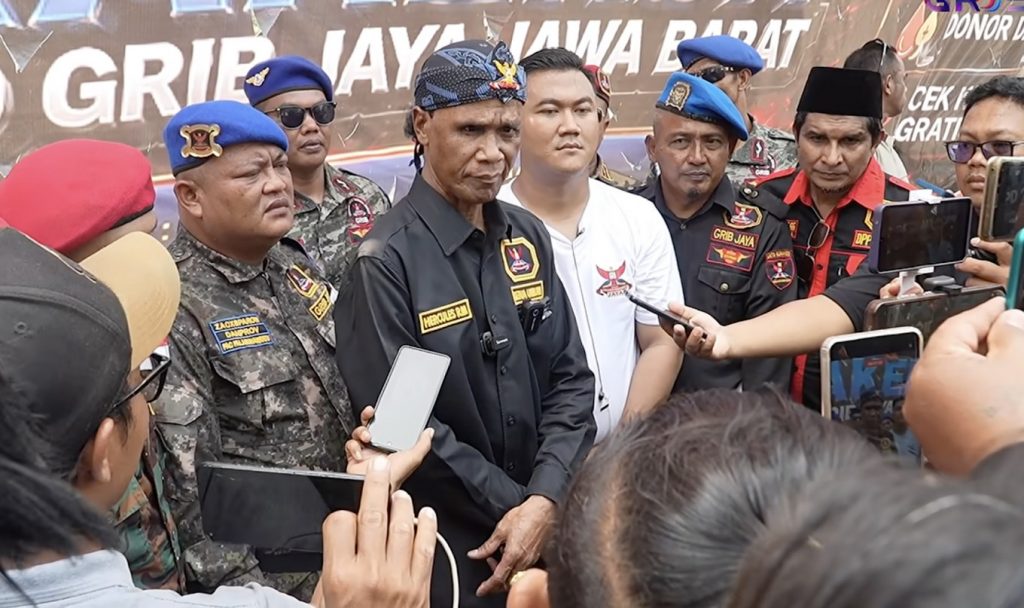
The involvement of a paramilitary group linked to street strongman Hercules (in the center of the picture ) in dispersing recent protests in Jakarta has raised troubling questions over whether President Prabowo Subianto’s administration is enabling, or even relying on informal coercive networks to maintain order as was common under the New Order government of President Soeharto. The group, United Indonesian People’s Movement (GRIB) Jaya, appeared on the streets as clashes between protesters and police spread from the House of Representatives building in Senayan to Slipi and Pejompongan Raya, some two kilometers from the legislative complex, on Thursday night. Videos circulating on social media showed groups of men, many wearing white headbands and some carrying bamboo poles and wooden planks, arriving in trucks and chasing and beating people near the Slipi overpass. GRIB Jaya secretary-general Zulfikar acknowledged that Hercules and members of the group were present in Jakarta streets on Thursday night, acting on their own initiative as part of what he called “Pam Swakarsa”, a New Order-era term for armed civilian groups mobilized alongside security forces to disperse protesters.
The episode has also drawn scrutiny because of Hercules’ longstanding ties to Prabowo. The former Timor Leste-born gang leader rose to prominence in Jakarta’s Tanah Abang textile market in the 1990s after building a formidable preman (gangster) network and has faced multiple arrests and prison terms over cases involving extortion, assault, property damage and land disputes. Hercules, whose real name is Rosario de Marshal, forged a close relationship with Prabowo when the latter served in the Indonesian Military in East Timor during the 1980s.The ties have continued since Prabowo took office in 2024. A May report by Tempo said Prabowo had begun distancing himself from Hercules in 2019, citing people close to the President who said he believed Hercules could be easily used by various parties. In March, however, Cabinet Secretary Teddy Indra Wijaya, a close aide to Prabowo, met Hercules at his Jakarta office and referred to him as “an old friend”. Its not clear that Prabowo ordered Hercules and his followers into the streets. However, neither has he sent a message that his government is not dependent on thugs, informal loyalists or coercive groups. (Jakarta Post).
OPM Kills 3 in Papua
Police are hunting suspected members of the Free Papua Movement (OPM) after three civil servants, two women and a man, were shot dead while on duty in Jayawijaya regency, Papua Highlands, on Wednesday. According to Sr. Comr. Yusuf Sutejo, spokesperson for the Operation Cartenz Peace task force, the incident occurred at about 4 p.m. local time as a group of 11 employees from the Jayawijaya Agriculture Agency were returning to the regency capital of Wamena from Muliama district, some 20 kilometers away. “The group had earlier inspected a site for a planned rice field and distributed food and livestock aid to residents in Muliama district. As they were returning to Wamena, however, they were stopped and fired upon by an armed group suspected of being members of the OPM from the Nduga area,” Yusuf said on Friday. The West Papua National Liberation Army (TPNPB), the armed wing of the OPM, has claimed responsibility for the shooting. They maintained those shot were intelligence officers who fled a roadblock. However, as reported by the Jakarta Post the victims have been identified as Aprida Rapi, 49, head of the livestock division at the Jayawijaya Agriculture Agency, Willi Mbuik, 24, a civil servant at the agency, both women, and Alfonsius Albinus Mehan, 34, a veterinarian. (Jakarta Post)